
Lyme Regis is a quaint, genteel sort of town. It has a beautiful sea front, facing the broad expanse of Lyme Bay, and the Cobb harbour, made world-famous when it was featured in the film 'The French Lieutenant's Woman'


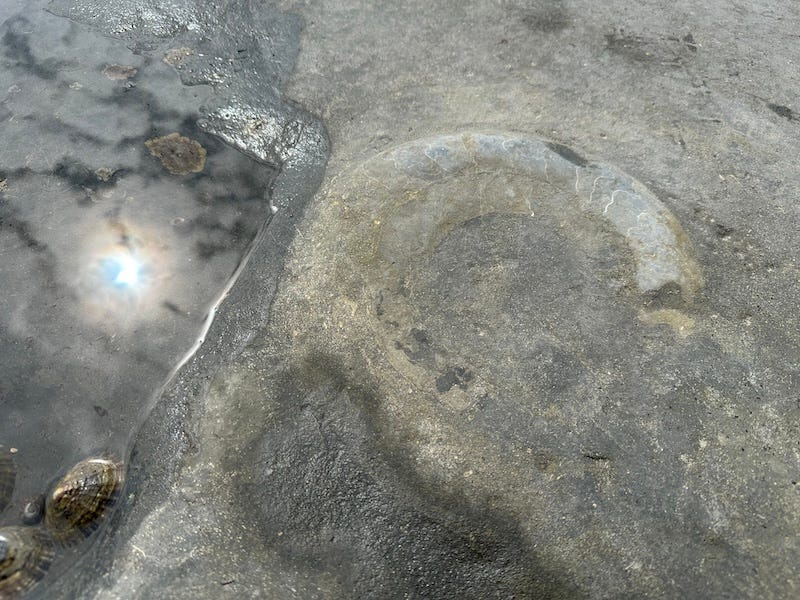
Lyme Regis is the place for fossils. Visit the Dorset town at low tide and you’ll find something. The ammonite fossil shells are unmissable.
 |
Lyme Regis is justly famous for its fossils, and for the work of fossil hunter Mary Anning (1799-1847). Anning and her brother Joseph made some stunning finds on this stretch of coast, including important examples of ichthyosaurs, plesiosaurs and pterosaurs.
Her life story is very well told above the beach at the superb Lyme Regis Museum, which stands on the site of her house and fossil shop. But the museum also draws us into the lives of other remarkable women associated with Lyme Regis. Jane Austen, for example, set much of Persuasion in the town. Meryl Streep brought it to the big screen in the adaptation of The French Lieutenant's Woman. And before you even reach the museum door, you must step over the the legacy of a famous London businesswoman, Eleanor Coade:
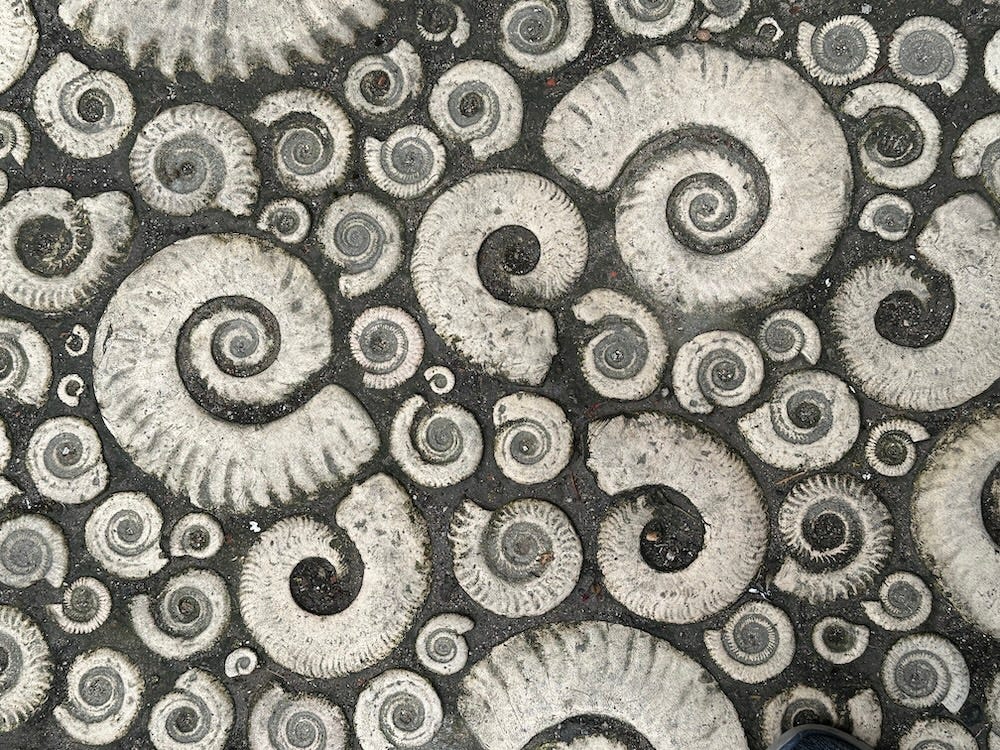 |
Eleanor Coade (1733-1821) made fake stone. She was really good at it. The curly forms in the photo above are not real ammonites, and nor are they sculpted. These are Coade-stone casts, and they are very convincing.
Coade stone was a revelation in the late 18th century. Others had made artificial stone before, but Eleanor perfected a recipe that was durable and weather-proof. Its chief advantage over real stone was that it could be poured into a mould, then fired until it became hard. Statues and architectural ornaments could now be mass produced without the need for expensive chisel-hours.
Georgian London was awash with Coade stone, and you can still find examples all over the city. The most famous is surely the dazzling white lion who guards Westminster Bridge.
Eleanor Coade was a serial entrepreneur. By the mid-1760s (still in her early 30s) she was running a linen drapers in the City of London. By the 1770s, she was directly managing the artificial stone factory in Lambeth. You don’t need me to tell you how rare it was for a woman to run a business in the 18th century, let alone a highly successful firm with royal warrants to both George III and the Prince Regent. Coade must have been exceptionally skilful to overcome the male gatekeepers of the time, even with wealth on her side.
Incidentally, the ‘recipe’ and firing technique for Coade stone were lost in 1840s after the factory closed down. Only in recent years has it been revived. The ammonite pavement at Lyme Regis Museum is one such modern example.
The museum didn’t choose Coade stone arbitrarily. Eleanor Coade had strong links to the area. She was born a little to the west in Exeter, into a wealthy Devon/Dorset family. She would later move to London, but also maintained an enviable bolt-hole in Lyme Regis.
Belmont had another celebrity occupant in more recent times. It was here that the novelist (and former Londoner) John Fowles lived from 1968 until his death in 2005. And it was here that he finished writing The French Lieutenant’s Woman, which includes Belmont as a setting.
Eleanor Coade’s wider story is well told inside the museum, and numerous accounts can be found online. Historic England has a map of Coade across the country). But Eleanor Coade is just one famous Londoner to have links with this part of the Jurassic Coast.
I began with Mary Anning and I’ll finish with Mary Anning. The great fossil hunter had only tenuous connections with London. As a woman of the early 19th century, she was barred from joining the learned societies of the capital, though she did correspond with many of the leading lights. Anning spent almost all of her time in Dorset, contributing much to our understanding of ancient life and the vastness of geological time. Tragically, her own time was to be short. Anning died of breast cancer aged just 47. Had she lived another 12 years, she would, I’m sure, have been utterly thrilled to see the publication of Darwin’s On the Origin of Species, which finally made sense of the “endless forms most beautiful” that she had chiselled from the rocks.
Thanks to a campaign by locals, she now has a statue on the Lyme Regis seafront. Lovely though this is, her real tribute is down in the ammonite beds of low tide. To paraphrase Christopher Wren’s tomb in St Paul’s “If you seek her monument, look around you”.

No comments:
Post a Comment