
The huge wheel was erected to mark the Millenium, and has remained a firm favourite with tourists. A 'flight' takes around 25 minutes, which translates to a speed of about 0.9km (0.6 miles) per hour, and the views from the highest point of the revolution are amazing. It's probably the only place in London where you can see the Houses of Parliament and Battersea Power Station in the same field of vision


The central struts of the London Eye align almost perfectly with the long-vanished Emergency Bridge No. 1. It straddled the Thames between the future site of the Eye and the Ministry of Defence Building (itself under construction at the time).
As you might suppose, the purpose of this bridge was to act as backup if either Westminster Bridge or Hungerford Bridge (which had a pedestrian crossing as well as rail links) were to be clobbered. This was a vital corridor of communication, with London’s local government based in County Hall on the South Bank, and the various ministries of national government just across the water in Whitehall.
This Emergency Bridge was painted in watercolour by artist Frances Macdonald in 1945:
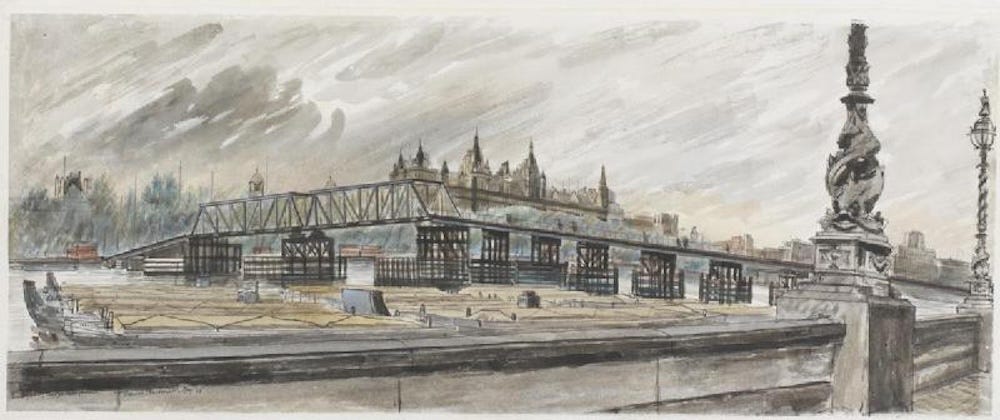 |
The sketch gives us a good impression of the bulk of the bridge. It had to clear the river by some height, with two large central spans to allow shipping to pass. We can also get a feel for just how much timber went into the supporting columns (as well as the decking and foundations).
Unlike the unused bridge in front of Tate Britain, this one did enjoy a bit of wartime action. There was a strike by a V-1 flying bomb. It piled into the side of the bridge on 18 June 1944. A whole section of track fell into the Thames, but fortunately nobody seems to have been injured. The adjacent pedestrian walkway was also destroyed.
In response, the authorities opened the Emergency Bridge to foot traffic. By all accounts, it was little used. An Evening Standard reporter — Arthur La Bern, who would go on to write the novel behind Hitchcock’s Frenzy — crossed the bridge in October. He provides one of the few first-hand accounts of these Emergency Bridges. He was not impressed.
“The most dejected, deserted, forlorn-looking bridge I have ever seen,” was the verdict. “I spent an hour on the bridge and did not see more than half a dozen pedestrians cross it”. One reason, he discovered, was that a spurious ‘do not use’ notice was still pinned to the southern end. Britain’s wartime logistical planning was not always a well-oiled machine.
It seems there was little demand for any pedestrian crossing here, at least outside rush hour. Everyone used Westminster Bridge. Few noticed when Hungerford footbridge reopened in November. “After several hours,” reported the Evening News, “only one man, an Army Corporal, had crossed the Thames by the footpath.”
Like the Millbank Bridge, the crossing to County Hall lingered around for three years, but did see some minor use. It served as a fireworks platform during the Victory Celebrations of 1946 and, according to one newspaper aside, it briefly reopened in November 1947 to help with the crowds for the wedding of Princess Elizabeth and Prince Philip. After that it was taken apart for recycling. The strong Douglas fir piles and wooden decking were largely taken on by London County Council, providing material for some 600 new houses.
Another cache of wood — ‘250 standards of timber’ — was retained at the riverside. Towards the end of the 1940s, the embankment between Westminster and Waterloo bridges was expanded further into the Thames as part of preparations for the 1951 Festival of Britain. The old bridge timbers were reused in its construction, and may still be down there.
As it transpired, the bridge should have been left intact. It would have been extremely handy for the 1951 Festival. Instead, a new bailey bridge was constructed by the Army along the upstream side of Hungerford Bridge, and demolished again soon after the Festival. Today, one of the magnificent Golden Jubilee Footbridges stands here.

No comments:
Post a Comment